Showing posts with label mud season. Show all posts

Saturday, February 25, 2017

mud season, alders, cattails...

We could hear the red-winged blackbirds - the males - across the (former) pond this morning. First time this year - February 25 - in years past, that's happened pretty much on the equinox. So, early.

It's been warmer lately and with the snowmelt, the stream that runs through our property has swollen considerably. I went out for a walk before breakfast with just the phone for a camera. Macro is generally unsatisfactory on the phone but I feel like I synced my brain a little better today.

My last shot before things seemed to click: this is what I think of as a pretty typical attempt at a somewhat close-up on my phone. It looks great on the phone itself, but any bigger, and it gets unacceptably blurry to me.


last year's female catkins.

Still, though, it inspired me to spend a little while letting the phone figure out how to focus on what I wanted it to focus on. 


There we go. 

This year's male catkins? sheesh, that specificity of knowledge has been put in back storage, apparently. It's been a while.

Onto the perennial favorite, exploded cattails. I think these shots came out okay....I should get out the Nikon with its macro lens and re-train my brain to really see the world...


Oh, fluffy goodness.


They should call these 'catbellies'.


No wonder this stuff used to be used as bedding. 


The Nikon would be even better at getting the mist drops.


Zero clue who this is - I need to brush up.
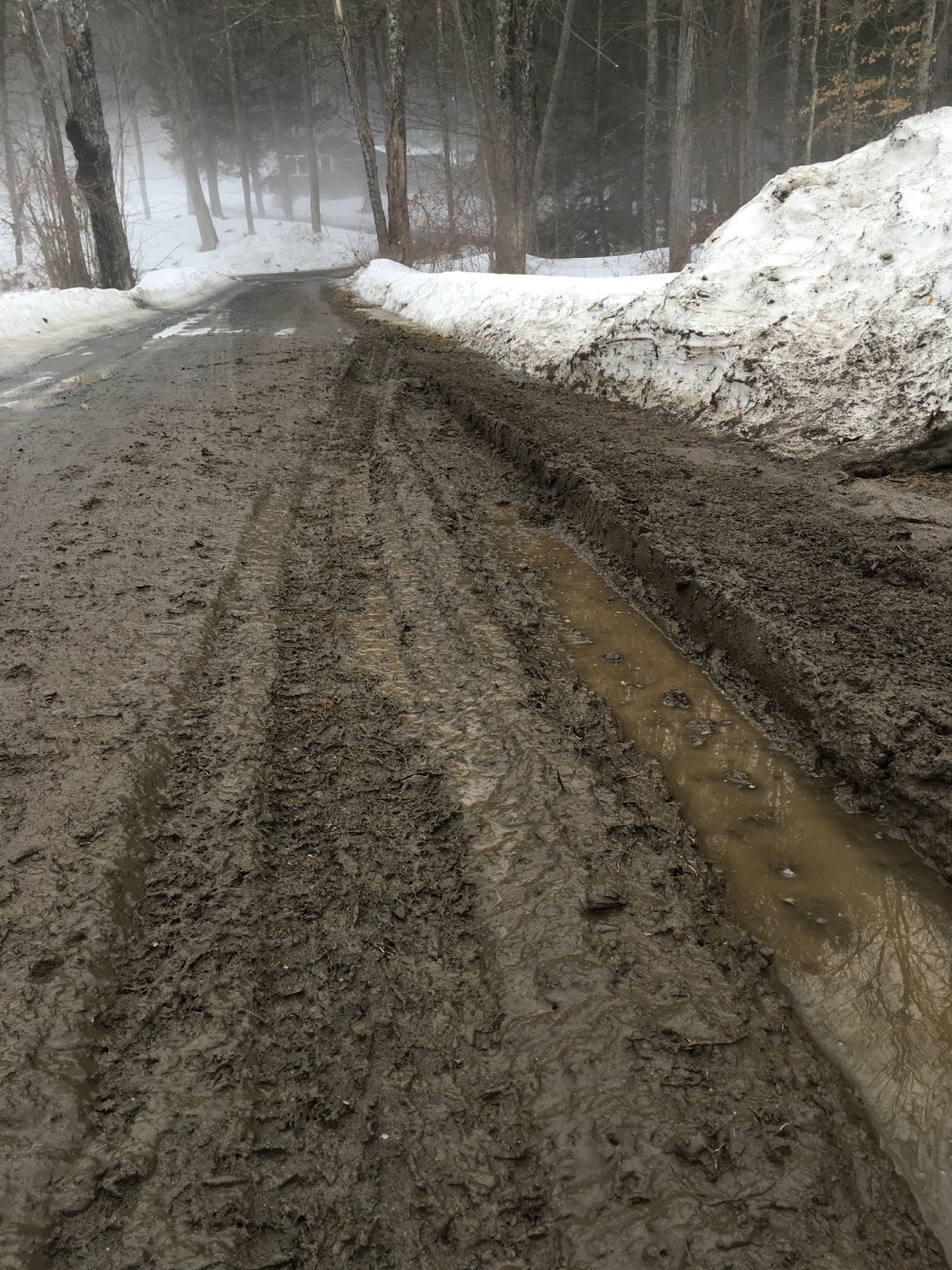

Ahhhh, mud season... 

It's the weekend. Fortunately, "The Hidden Life of Trees" became available from the library, via Kindle. I already know, a few paragraphs into the prologue, that I'm going to have to buy this one. 

Saturday, March 26, 2011

buddaliciousness


Mmmmm…mud season!
P1040997
We’re in a cold snap. It’s been about 32° all day, and it’s supposed to go down to 17° tonight. On today’s perambulation, I noticed ice forming in the ruts:
P1050001
Let’s see how the buds are coming along, shall we?
P1040956P1040957
Lilac – Syringa vulgaris. Lilacs, along with ashes, maples, some dogwoods, and a bunch of shrubbier things like viburnums, are “opposite” – meaning their branches are paired. You see that even when they are wee little buds, and interestingly, as I saw today, sometimes one bud is bigger than another. I wonder what that will look like when the buds pop open.
I may have evidence that the ashes are waking up just the tiniest bit.
P1040830
Here’s the terminal bud of an ash sapling on March 15th.  See how tightly clasped the two bud scales are?
P1040998
And here’s the same sapling, nine days later. Doesn’t the top seem to be opening up a bit? Which would be odd, if only because in my experience, the ashes are among the last to get going in the spring.
P1040864
Witchhazel – Hamamelis virginiana, as of March 18.
P1040966
No obvious change as of today. BUT, I knew there was something different about it lately…I racked my brain.
My brain suggested I google my own blog, and lo and behold, check this out:
P1030923
January 10. It’s gray! Not yellow! Aha!
Onwards.
P1040972
Gray birch – Betula populifolia. I really don’t have much to observe here, but I figure this will be a good point of reference when this opens up, eventually.
P1040975
Same gray birch – a male catkin. When the catkins explode – that will be fun. That’s got to be weeks away. I love the basket weave look of this. I do wish this were in a bit crisper focus.
P1040985
More gray birch…
And now, on a sadder note, let’s look at some black knot fungus.
P1040977P1040965
These cherry trees are infected. I don’t think there is much to be done about it – the fungus spreads via spores, and once it takes hold, it gradually spreads over the whole tree and snaps the twigs. Eventually the tree succumbs.
The pathogen's presence disrupts the normal growth of the twigs and a tumor-like growth forms at the infection site. Infections may take place as much as a year or more prior to the development of these characteristic "knots", therefore, the swellings are normally not noticed until the winter of the second season of infection. It takes a keen observer to notice the subtle, initial symptoms present during the first season of infection.  Source
And now, as your reward for studying all the buds with me, here are some landscapes.
P1040947

P1040948
P1050004
The thing to notice here is, the profusion of buds. Let’s zoom in.
P1050003
Ahh! the buds are actually opening up, too! Yay!